
Digital content strategy for high-impact signage results
TL;DR:
- A digital content strategy involves high-level planning, creation, and governance matching audience needs.
- Effective signage requires specific, audience-tailored content updated regularly with cross-departmental collaboration.
- Most strategies fail due to passive content, lack of measurement, and absence of clear goals and governance structures.
Most marketing and communications leaders assume that loading a playlist of slides onto a screen counts as a digital content strategy. It does not. A genuine digital content strategy is the high-level planning, creation, distribution, and governance of content across digital channels to meet specific business goals and audience needs. For digital signage, this distinction matters enormously. Screens that display random, unplanned messages blend into the background. Screens that deliver intentional, audience-matched content drive behavior, build trust, and generate measurable results. This guide walks you through the definition, core components, critical pitfalls, and real-world application of a digital content strategy built for signage.
Table of Contents
- What is digital content strategy?
- Core components of a successful digital content strategy
- Critical pitfalls: What undermines digital content strategies?
- Applying content strategy to digital signage: Real-world scenarios
- Why most digital content strategies fall short—and how to break the mold
- Take the next step with digital signage expertise
- Frequently asked questions
Key Takeaways
| Point | Details |
|---|---|
| Strategy vs marketing | True digital content strategy focuses on structured planning and governance, not just content creation. |
| Success steps | Define goals, understand your audience, and measure performance for effective digital signage. |
| Avoid common pitfalls | Regularly update content and involve cross-functional teams to maximize audience impact. |
| Collaborative advantage | Involving stakeholders boosts originality and relevance in digital signage campaigns. |
| Tech plus human | Automation enhances strategy, but human insight and oversight remain essential. |
What is digital content strategy?
The term “digital content strategy” gets used loosely in most marketing conversations. People often treat it as a synonym for content marketing, but the two are fundamentally different things. Understanding that gap is the first step toward better signage outcomes.
A digital content strategy is the framework that governs what content gets created, why, for whom, and how it gets managed over time. Content marketing, by contrast, is the execution layer. It handles the actual production and promotion of content. Mixing the two up, or treating them as interchangeable, often leads to what researchers call a “content pile”: a growing library of unstructured material with no clear connection to organizational goals.
“When organizations confuse strategy with execution, they tend to produce high volumes of content that look busy but fail to move audiences through any meaningful journey.” This pattern is especially common in organizations scaling digital signage quickly without a governance structure in place.
For digital signage specifically, the stakes are high. A screen in a hotel lobby, a hospital waiting room, or a retail store has maybe three to seven seconds to capture attention. Without a strategy defining the right message for the right audience at the right moment, that opportunity is wasted every single time.
A well-built digital content strategy for signage covers the following elements:
- Goals and KPIs: What specific outcomes do you want from each display or network of displays?
- Audience definition: Who is standing in front of the screen, and what do they need at that moment?
- Content governance: Who approves, updates, and retires content? What are the rules?
- Channel and format selection: Which screen locations, orientations, and content formats serve each audience best?
- Adaptation and iteration: How do you learn what’s working and adjust continuously?
Explore digital content strategy methods for hotels for a practical example of how these elements come together in a high-traffic hospitality environment.
Core components of a successful digital content strategy
Defining strategy is only useful if you know what actually goes into it. Let’s break down the process.
Most robust content strategy methodologies follow a six to seven step process: define goals and KPIs, conduct audience research and build personas, audit existing content, map content to the audience journey, select formats and channels, build a workflow and editorial calendar, and then measure and optimize. For digital signage teams, each of these steps has a direct and practical application.
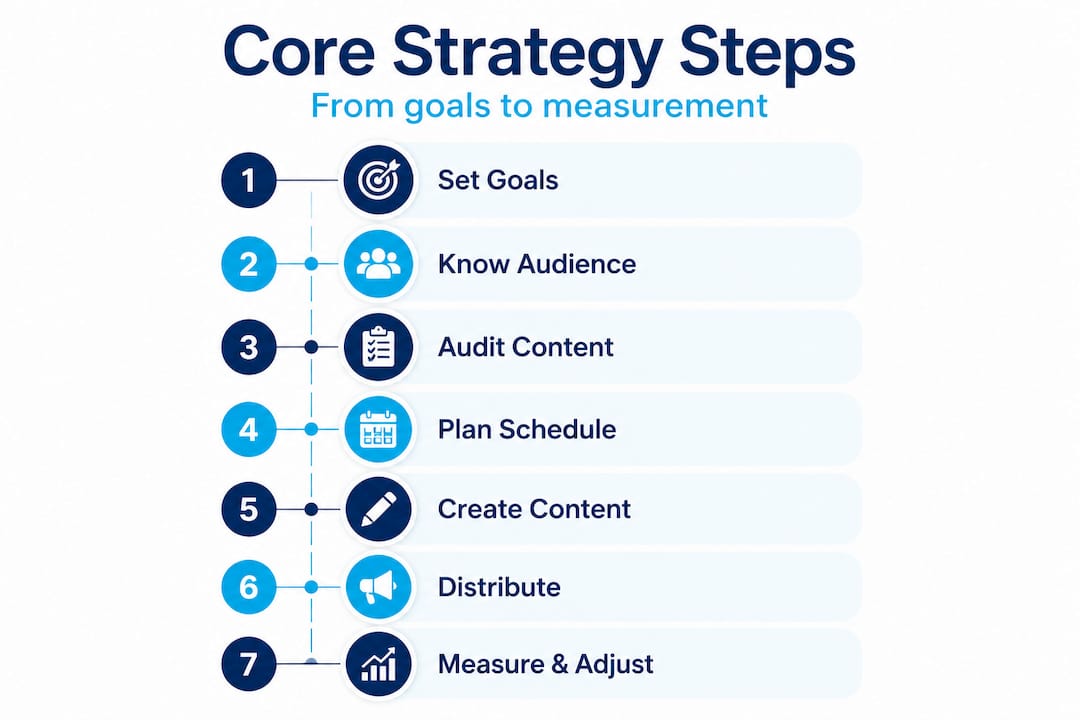
| Strategy step | Digital signage application |
|---|---|
| Define goals and KPIs | Set screen-level goals: foot traffic increase, dwell time, product awareness, or wayfinding efficiency |
| Audience research | Map who visits each screen location: guests, patients, employees, or shoppers |
| Content audit | Review current playlists for outdated messages, duplicates, and gaps |
| Journey mapping | Sequence content to guide viewers from awareness to action across touchpoints |
| Format and channel selection | Choose video, static image, data widgets, or live feeds based on context |
| Editorial calendar | Schedule updates by location, time of day, day of week, and seasonal relevance |
| Measurement and optimization | Track engagement proxies: dwell time, scan rates, conversion from screen-visible promotions |
Here is a step-by-step walkthrough of how this works in practice for a signage project:
- Set screen-specific goals. A lobby screen and a cafeteria screen serve different audiences with different mindsets. Define what success looks like for each.
- Build audience personas per location. Persona work is not just for websites. Knowing whether your viewer is a stressed patient, a browsing shopper, or an employee on a lunch break changes everything about tone, format, and message length.
- Audit what you already have. Most organizations have more content than they realize, and most of it is either outdated or misallocated. A content audit prevents duplication and surfaces reusable assets.
- Map content to intent. Use the awareness, consideration, and decision framework to assign content types to each stage of the viewer’s journey in that location.
- Assign roles and tools. A content manager handles scheduling. A designer maintains visual consistency. A data analyst tracks performance metrics. These roles can overlap in smaller teams, but they must be assigned.
- Build the calendar and workflow. Content with no schedule gets updated reactively, which means it gets stale. Build a workflow that includes review, approval, and publication steps.
- Measure and adapt. Use the measuring ROI for signage framework to evaluate what is actually driving outcomes, not just what is easy to count.
The right content creation tips for signage will help your team execute each step with greater efficiency and creative impact.
Pro Tip: Most organizations invest heavily in steps one through six and then abandon step seven entirely. Measurement and optimization are where long-term signage value is built. Without them, you are repeating the same guesses indefinitely.
Critical pitfalls: What undermines digital content strategies?
Understanding what to do is just half the battle. It is vital to avoid typical failure points.
One of the most consistent findings in content strategy research is that organizations over-invest in top-of-funnel (TOFU) content and neglect middle and bottom funnel stages. For digital signage, this translates to screens full of brand awareness messages with no clear next step for the viewer. Awareness without guidance does not convert.
Another major pitfall is stale content. Stale content leads to screens being ignored, a phenomenon sometimes called “screen blindness.” Audiences that see the same message repeatedly stop registering it entirely. In high-frequency venues like hospitals, airports, and offices, content should be refreshed two to three times per week to maintain relevance and attention.
Here is a direct comparison of effective strategy versus common failure patterns:
| Effective strategy | Common pitfall |
|---|---|
| Defined goals per screen location | One generic playlist for all screens |
| Regular content refresh schedule | Content set once and forgotten for months |
| Human-led, research-backed messaging | Full reliance on AI-generated content without editorial oversight |
| Centralized governance with local flexibility | No governance model, anyone can publish anything |
| Content matched to audience journey stage | Only awareness content, no calls to action |
| Cross-functional collaboration | Single-person content silos with no external input |
Additional pitfalls that undermine signage content strategies include:
- Over-reliance on AI tools. AI-generated content, when used without human curation and strategic input, correlates with lower performance outcomes. AI is a useful assistant, not a replacement for strategic thinking.
- Lack of governance. Without clear ownership of who updates content and who approves it, quality degrades quickly. Enterprise-scale signage networks especially need hybrid governance models: central templates that enforce brand standards, with local teams empowered to update time-sensitive content.
- Ignoring the physical context. A digital strategy designed for a website does not automatically transfer to a physical screen. Viewing distance, ambient noise, lighting, and dwell time are all factors that must shape content design for signage.
- No measurement framework. If you are not tracking any performance signals, you have no way to distinguish what is working from what is being ignored.
External research on digital presence for hotels reinforces that organizations investing in structured digital strategies consistently outperform those operating reactively.
Pro Tip: For digital signage in high-frequency environments, treat content like a perishable product. Set expiration dates on every piece of content at the time it is published, and assign a team member to review the queue weekly.
Applying content strategy to digital signage: Real-world scenarios
Once you know what to avoid, it is time to focus on what works best in real environments.
Let’s look at how organizations across different sectors put these principles into practice.
Retail environment: A national clothing retailer uses a tiered signage strategy across store entrance, mid-floor, and point-of-sale screens. Entrance screens run awareness content tied to seasonal campaigns. Mid-floor screens highlight product features and styling combinations. Point-of-sale screens show current promotions and loyalty program reminders. Each layer serves a distinct stage of the shopper’s journey, and content is updated three times per week to reflect inventory changes and regional promotions.

Healthcare setting: A regional hospital network separates content by audience. Patient-facing screens in waiting areas display wellness education, appointment reminders, and estimated wait times updated via a live data feed. Staff-facing screens in break rooms show HR announcements, safety protocols, and scheduling updates. Each content stream has a designated owner and a weekly review cycle.
Corporate office: A professional services firm runs a single screen network across three office floors. Content is managed centrally through a cloud dashboard, but each floor’s content manager can push location-specific announcements. The strategy includes a monthly content audit where outdated messages are retired and new priorities are scheduled. Performance is tracked by measuring employee awareness scores in quarterly internal surveys.
These examples share a common thread: collaboration over volume. Each organization involves stakeholders from multiple departments, uses data to inform updates, and prioritizes relevance over quantity.
Actionable improvements you can apply immediately:
- Involve stakeholders from operations, HR, and marketing when defining content goals for each screen location.
- Mix content types: combine static announcements with video, live data feeds, and interactive elements to maintain visual variety.
- Schedule updates proactively rather than reactively. A content calendar prevents the “we forgot to update the screens” problem.
- Use examples of display content to benchmark your current content mix against what is proven to drive engagement.
- Review your display templates for marketers to ensure visual consistency across all locations without requiring a designer for every update.
Pro Tip: Effective signage strategies lean heavily on collaboration and original, organization-specific content. Viewers respond to messages that feel relevant to their immediate context. Generic content, no matter how well designed, rarely moves people to action.
Why most digital content strategies fall short—and how to break the mold
Here is an uncomfortable truth: most digital content strategies fail not because of poor execution, but because of poor strategic intent from the start. Organizations invest in hardware, software, and design but skip the foundational work of defining what the content is supposed to accomplish and for whom.
The result is exactly what researchers describe as a “content pile.” Screens display content because screens need to display something, not because the content serves a specific audience need. This is passive communication, and passive communication produces passive results.
What actually sets high-performing signage strategies apart is not volume or production quality. It is specificity. The organizations seeing real results from digital signage are publishing less content overall, but that content is tightly matched to the audience’s context, emotional state, and decision point. A hospital that shows a patient’s estimated wait time alongside a calming visual and a brief wellness tip is doing more strategic work in three seconds than a screen cycling through thirty generic slides.
The second differentiator is cross-functional input. Content created in isolation by a single marketing coordinator reflects a single perspective. Content shaped by input from operations, customer experience, IT, and leadership reflects the full complexity of what the organization actually needs to communicate. Breaking out of the internal echo chamber is not a soft recommendation. It is a structural requirement for sustained relevance.
The third differentiator is honest measurement. Most teams measure what is easy: number of screens active, content pieces published, or playlist completion rates. These metrics feel productive but rarely connect to behavioral outcomes. Ask harder questions instead. Is the screen in the lobby actually influencing where guests go first? Is the cafeteria screen changing what employees order? Is the waiting room content measurably reducing perceived wait time? These are the questions that lead to strategy improvements. Explore beyond basic signage tips for more on building a measurement mindset into your content process.
Take the next step with digital signage expertise
Ready to advance your strategy? Explore the resources that can accelerate your digital signage success.
DST Connect brings together everything covered in this guide into a single, user-friendly platform. The cloud-based dashboard lets you manage content across multiple screen locations worldwide, schedule updates in advance, and use real-time data feeds to keep messaging current without manual intervention. With over 700 professionally designed templates and a drag-and-drop editor, your team can produce high-quality, audience-specific content without needing technical or design expertise. Try the digital signage platform to see how strategy becomes execution without friction. If you want to go deeper on signage best practices, the DST Academy offers structured learning resources to build your team’s capability from the ground up. Join us and turn your screens into high-impact communication tools.
Frequently asked questions
How is digital content strategy different from content marketing?
Digital content strategy focuses on planning, governance, and alignment with organizational goals, while content marketing handles the actual creation and promotion of individual content pieces. Strategy sets the rules; marketing operates within them.
What are the first steps to building a digital content strategy for signage?
Start by defining your goals and KPIs, then research your audience for each screen location, and audit what content already exists before planning and scheduling anything new.
How often should digital signage content be updated for best results?
In high-frequency venues, updating content 2 to 3 times per week helps maintain audience engagement and prevents the screen blindness that comes from repeated exposure to the same messages.
What roles are essential in an effective digital content strategy team?
Core roles include a content strategist, a visual designer, and a data analyst, with collaborative input from marketing, IT, and operations to ensure content serves the full range of organizational needs.
Do AI tools replace the need for a human content strategy?
AI can assist with content generation and scheduling, but full AI-article writing without human oversight correlates with lower performance outcomes. Strategic judgment, audience empathy, and creative direction still require human leadership.
Recommended
- Content creation tips for signage to boost engagement
- How to engage audiences with signage: proven strategies for 2026
- Cost-effective signage: maximize impact, minimize spend
- Pro AV tips for signage: optimize displays in 2026
- Digital Signage Screen – Switch&Save
- How to target conferences and trade shows with LED mobile billboards
Enjoyed this blog?
Continue with the previous or next article and discover more ideas, insights and inspiration from DST Connect.