
Digital corporate communication: transform organizations in 2026
TL;DR:
- Digital corporate communication involves coordinating multiple channels for strategic messaging internally and externally.
- Successful strategies rely on audience segmentation, unified messaging, governance, feedback, and KPI tracking.
- Technology such as digital signage, AI, and automation enhance reach and relevance but must be balanced with human connection.
Most communication managers assume digital corporate communication means sending the right email at the right time. It doesn’t. In 2026, digital corporate communication spans a wide ecosystem of channels including digital signage, AI-driven messaging, intranets, social platforms, and mobile apps, all working together to align teams and inform stakeholders. Organizations that still treat “digital” as a synonym for email are leaving real performance gains on the table. This article breaks down what digital corporate communication actually means today, the strategic frameworks that make it work, the technologies powering it, and how to keep human connection at the center of every message you send.
Table of Contents
- Defining digital corporate communication in today’s organizations
- Strategic frameworks: Planning, segmentation, and governance
- Leveraging technology: The role of signage, AI, and automation
- Balancing digital efficiency with human connection
- Our take: Where digital corporate communication really delivers and where it falls short
- Transform corporate communication with DST Connect
- Frequently asked questions
Key Takeaways
| Point | Details |
|---|---|
| Comprehensive definition | Digital corporate communication blends technology, strategy, and people to engage internal and external audiences. |
| Framework essentials | Effective plans include segmentation, unified messaging, governance, and performance measurement. |
| Tech for impact | AI, automation, and digital signage boost speed and personalization but need human balance. |
| Hybrid is optimal | Combining digital reach with face-to-face empathy delivers lasting trust and engagement. |
| Practical tools available | Modern platforms make implementation easy, with structured solutions and ongoing support. |
Defining digital corporate communication in today’s organizations
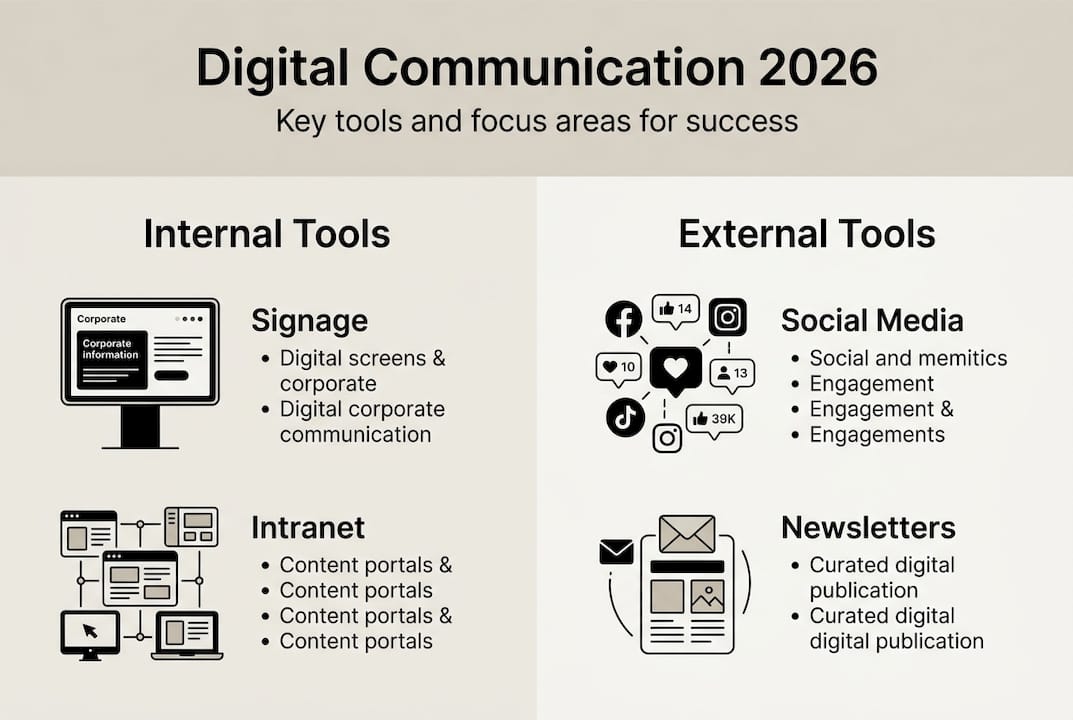
Digital corporate communication is not a single channel. It is the coordinated use of all digital platforms to deliver consistent, timely, and strategic messaging to both internal and external audiences. Think beyond the inbox. Digital signage in lobbies, employee apps on phones, real-time dashboards in warehouses, and social media posts for customers all fall under this umbrella.
The shift from traditional to digital communication has been fundamental. Traditional methods like printed memos, bulletin boards, and face-to-face-only briefings were slow and hard to update. Digital channels offer immediacy, reach, and measurability that print simply cannot match.
Key business objectives driving digital corporate communication:
- Real-time organizational alignment across departments and locations
- Higher employee engagement through relevant, targeted messaging
- Faster distribution of updates, policies, and announcements
- Measurable impact through analytics and feedback tools
- Strengthened brand consistency across all touchpoints
One helpful way to think about this: internal communication focuses on alignment and culture, while external communication targets customer trust and brand perception. Both require different tones, formats, and cadences, but they share the same need for strategic clarity.
| Dimension | Internal communication | External communication |
|---|---|---|
| Primary audience | Employees, managers | Customers, partners, public |
| Main goal | Alignment, engagement | Brand trust, awareness |
| Typical channels | Intranet, digital signage, apps | Social media, websites, displays |
| Update frequency | Daily to weekly | Campaign-driven |
| Measurement | Engagement rates, reach | Conversions, sentiment |
Digital signage is especially powerful as an internal channel. In retail settings, office digital displays drive both employee awareness and customer engagement simultaneously. In hospitality, digital signage in hospitality has become a core part of how hotels communicate with guests, a trend reinforced by digital transformation in hospitality reshaping organizational culture sector-wide.
Effective digital corporate communication relies on strategic planning with segmentation, unified messaging frameworks, governance structures with clear approval and escalation paths, continuous feedback loops, and KPI-based measurement. These are not optional extras. They are the foundation of any communication system that actually works at scale.
Pro Tip: Before expanding your digital channel mix, map your current channels to your audience segments. Many organizations discover they are over-communicating on some platforms and completely absent on others.
Strategic frameworks: Planning, segmentation, and governance
With the definition established, let’s look at systematic approaches to building effective digital corporate communication. A well-structured framework transforms scattered messaging into a coordinated strategy that drives results.
A practical five-step framework for digital corporate communication:
- Audience segmentation: Identify distinct groups inside and outside your organization. Frontline workers, remote employees, leadership, customers, and media partners all have different needs and preferred channels.
- Unified messaging framework: Define your core brand voice and ensure all communications reflect it, regardless of the channel or sender. Consistency builds credibility.
- Approval workflows: Establish clear escalation and review processes so every message that goes out is accurate, compliant, and on-brand. This is especially important for crisis or legal-sensitive content.
- Feedback loops: Build in mechanisms for two-way communication. Surveys, comment features, and direct response channels tell you whether your messaging is landing.
- KPI measurement: Track what matters. Message reach, open rates, engagement time on digital displays, and employee alignment scores all give you actionable data.
Hybrid approaches that balance digital speed with human empathy, backed by robust governance with escalation and approval processes, are essential to sustainable communication programs. A message sent fast but without accuracy or empathy can do more damage than no message at all.
Here is how leading organizations structure their KPI measurement across communication types:
| KPI | Internal focus | External focus |
|---|---|---|
| Reach | % of employees who saw update | Impressions, page views |
| Engagement | Click-through, dwell time | Likes, shares, comments |
| Alignment | Survey scores, pulse checks | Brand sentiment index |
| Compliance | Approval cycle time | Regulatory adherence |
For organizations using digital signage as part of their framework, proven audience engagement strategies and solid content creation best practices make it much easier to sustain high-quality, on-brand messaging at scale.
Pro Tip: Run a governance audit twice a year. Ask: Who approved the last five major messages? How long did it take? Where did bottlenecks occur? You will almost always find one or two steps that slow everything down unnecessarily.
Leveraging technology: The role of signage, AI, and automation
After setting up a strategic framework, it is critical to understand how technology powers modern digital communication. Tools are not the strategy, but they are what makes the strategy executable at scale.
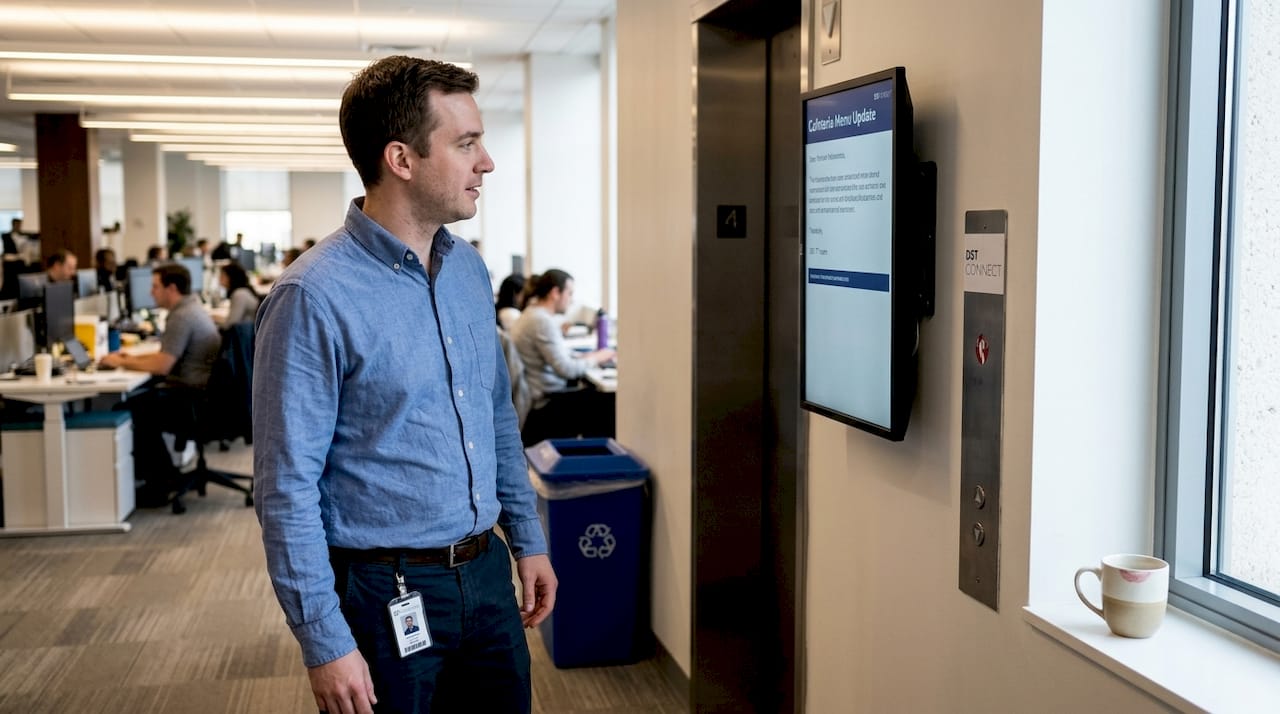
Digital signage delivers real-time, location-targeted updates without requiring recipients to check an app or open an email. A screen in a break room can show shift changes, safety alerts, company milestones, or customer satisfaction scores, all updated remotely and instantly. This is especially valuable in manufacturing, healthcare, and retail where workers spend little time at desks.
AI-driven communication takes personalization further. AI can analyze audience segments and automatically tailor message content, timing, and format based on behavior and preference data. It reduces manual effort while increasing relevance.
Automation allows organizations to schedule campaigns, trigger messages based on real-world events, and distribute content across hundreds of screens or channels simultaneously. The result is consistent, scalable communication without proportional increases in staff time.
“AI for 26 to 47% productivity gains but requires operating model redesign; digital alone is insufficient without face-to-face interaction.”
That last point is worth repeating. Technology amplifies your communication strategy. It does not replace the judgment, empathy, or leadership presence that makes communication credible. Organizations that automate everything and eliminate human touchpoints often see short-term efficiency gains followed by longer-term trust erosion.
What technology does well:
- Real-time updates across multiple locations simultaneously
- Personalization at scale based on audience data
- Automated scheduling and campaign management
- Analytics and performance reporting
- Integration with existing HR, CRM, and operations platforms
For practical inspiration, exploring display content examples shows how organizations across sectors use dynamic content to keep messaging fresh and relevant. AI tools are also gaining traction in adjacent sectors, as seen in the growing use of AI tools in hospitality and broader AI applications in hotels, signaling where corporate communication is heading across industries.
Balancing digital efficiency with human connection
The technological edge is vital, but true excellence means harmonizing efficiency with authentic human connection. This is where many digital communication strategies struggle.
Digital tools enable speed and scalability that were unimaginable a decade ago. You can reach 10,000 employees in different countries within seconds. But speed without empathy is not communication. It is broadcasting.
Crisis communication demands rapid, empathetic, and credible responses. And 86% of consumers prioritize human connection, especially during uncertain or high-stakes moments. No automated message can fully replicate the reassurance of a credible leader speaking directly and honestly.
There is also a real paradox in hybrid work environments. Digital tools improve convenience, but face-to-face interaction still drives higher satisfaction and trust. Organizations that go fully digital often see engagement metrics rise while deeper satisfaction scores fall.
Practical ways to balance digital efficiency with human connection:
- Use digital signage and apps for routine updates; reserve face-to-face or video for complex or emotional topics
- Train leaders to deliver key messages personally before automating follow-up distribution
- Monitor digital channel fatigue by tracking unsubscribe rates, display dwell time, and employee survey feedback
- Build in regular town halls or team check-ins that no digital channel replaces
- Apply ethical guidelines to all AI-generated content, including disclosure where appropriate
For organizations using digital signage for announcements, the best results come from pairing the channel with leadership visibility, not replacing it.
Pro Tip: Identify your three most important annual communication moments and keep them human-led. Use digital tools to extend their reach, not to replace the moment itself.
Our take: Where digital corporate communication really delivers and where it falls short
Taking all evidence and real-world pitfalls into account, here is our unfiltered perspective.
Digital corporate communication genuinely excels at reach, speed, and consistency. A well-managed digital signage network in a corporate campus can deliver a unified message to every employee simultaneously, something a team of internal communicators could never do manually. The data feedback loop is also a real advantage: you can see what content gets attention and adjust in near real time.
But here is what most guides won’t tell you: digital communication is only as strong as the leadership culture behind it. We have seen organizations invest heavily in screens, platforms, and automation tools, only to have employees tune out because leadership never appears in person. The technology gets blamed, but the real issue is that digital was used as a substitute for presence rather than a supplement to it.
The organizations that do this best audit their digital channel mix regularly, using tools like optimizing digital display processes to stay sharp, and they actively solicit honest feedback from employees, not just engagement metrics. Numbers can lie. Conversations reveal what is actually going on.
Our advice: do not add a new digital channel until you know why your existing ones are underperforming. More is not always better. Focused is.
Transform corporate communication with DST Connect
Ready to move from understanding to implementation? The right tools make all the difference. DST Connect makes it straightforward for communication managers to deploy and manage professional digital signage across any number of locations, without needing technical or design expertise. With over 700 templates, a drag-and-drop content editor, real-time data feeds, and a cloud-based dashboard, you can keep every screen in your organization current, consistent, and on-brand.
Whether you are improving internal alignment or strengthening external brand presence, explore our digital signage software to see how DST Connect fits your communication strategy. Deepen your knowledge and sharpen your skills by visiting DST Academy resources. Start your free trial today and see the difference focused, well-managed digital communication can make.
Frequently asked questions
What is the difference between digital and traditional corporate communication?
Digital corporate communication uses technology-driven channels like digital signage, AI, and intranets for real-time, scalable messaging, while traditional methods rely on print, in-person meetings, or phone calls. Digital excels in speed and reach, but face-to-face methods still drive higher satisfaction in many contexts.
How can organizations measure the success of digital corporate communication?
Success is measured through KPIs such as employee engagement rates, message reach, real-time feedback scores, and alignment with organizational goals. Measurement via KPIs and continuous feedback loops is a core pillar of any effective digital communication strategy.
What role does AI play in modern corporate communications?
AI automates stakeholder messaging, personalizes content at scale, and can deliver 26 to 47% productivity gains, but it requires ethical guidelines, human oversight, and integration into a redesigned operating model to be effective.
Why is human connection still important in digital communication?
Even with advanced digital tools, empathy and credibility are best achieved through human-led interactions, particularly during crises. 86% of consumers prioritize human connection and organizations that ignore this risk trust erosion regardless of how sophisticated their digital channels are.
Recommended
Enjoyed this blog?
Continue with the previous or next article and discover more ideas, insights and inspiration from DST Connect.